

After a long gap, I opened the book of "Supa shastra" in Kannada. Surprisingly, the word supa in Sanskrit is used in the same sense of English "soup' meaning broth of meat or vegetables. But later it came to denote cooking in general. Hence Supashastra meant "Science of Cooking".
This book on Supashastra of Mangarasa written around 1509 has been edited by S.N. Krishna Jois, an erudite scholar in Sanskrit and Kannada languages. It is an exemplary record of editing ancient texts, especially palm-leaf texts. Mr. Jois has consulted nine available manuscripts, five of them being on palm-leaves and four on old papers. In the introduction he has given a comparative reference of similar Sanskrit and Kannada works and in the annexes, he has extensively quoted passages from ancient Kannada Kavyas, where in reference to food and culinary art occurs.
Mangarasa claims that he wrote the book for the benefit of house-wives. It is in verse form. The book has six chapters and according to Shri Jois the work is incomplete. The first chapter deals with thirty five snacks most of which have become obsolete. Some have survived. Jangir is one but it has beautiful name of Amritavallari (ambrose-creeper)! Chandra mandala fortunately carries more or less the same name Chandrahara. Some have funny names like Babar, Gujjariveni (apparently sounds like hair-pleat of a Gujjar woman!) and Sakkare burude (sugary blow-ups).
The second chapter deals with various soft drinks. sour, salty and sweet. These were prepared from juices of different fruits, milk and buttermilk. Various puddings and rice-varieties figure in third chapter, details of which are mind-boggling. The fourth chapter consists of mouth-watering curries. Twenty one types of curries of egg-plant (badanekai) and twenty five varieties of raw banana, along with banana stem and flowers are described. Fifth chapter deals with green gourd (kumbalakai) and jack fruit savories and the last chapter gives preparations of bamboo shoots and myrobalan.
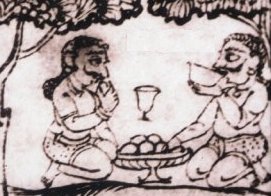
The culinary process given by Mangarasa is long and elaborate. One agrees with the editor that it is above the reach of commoners, who always prefer `handy' and quick-to-make or instant dishes. Human effort put in to obtain finest flour or sooji by manual labour, in the days when flour-mills were not known is only left to the imagination as also the laborious process of grinding, stuffing and frying.
Most interesting part is the existence of Tandoor Oven. Tandoor, a Sanskrit word, was used for slow steaming or baking. Native Kannada oven was also there. An earthen pot layered inside with pure ghee and dough with ingredients was kept in a bigger earthen vessel layered with wet mud from outside and covered with a baked roti as lid. It was kept on cinders. When the wet mud fell burning it indicates that the dish was done.
Sugar free drinks, use of lot of fibrous fruit as also natural fermentation only shows that the concept of balanced diet was known to older generations.
This book on Science of Cooking is a splendid example of the finesse India reached in the most popular art in all times and climes.
The book:
Supa Shastra of Mangarasa (Science of Cooking)
edited by S. N. Krishna Jois
published by the Institute of Kannada Studies,
University of Mysore.
First edition 1969

• Topics on Indian Food
• Food and Food Habits in Vijayanagar Times