


Well, one thing is common to Indian women. They are extremely fond of ornaments! Apart from hands, shoulders, fingers, waist, ankles and feet, (fingers) they are capable of displaying innumerable ornament. Hair, ears and nose are no exception. On the ear-lobes at 4-5 places upper lip and inner thinner ear part are also pierced to sport dainty jewels. Hence the ear itself has three-four ornaments at times linked by a light chain.
© K.L.Kamat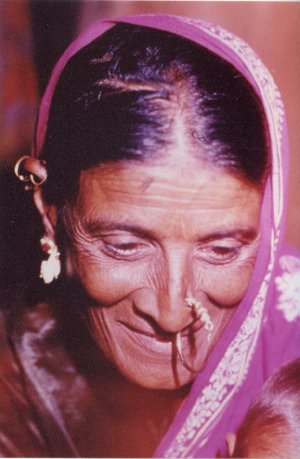
Portrait of a Muslim Woman
Portrait of a Muslim woman with a huge nose ring
Nose-ornament is not native to India. There is no mention of nose ornament in Vedic literature or other sacred texts. Ancient sculptures do not depict it. Neither is it mentioned in Amarkosh, the ancient lexicography, nor in Bharata's Natyashastra, which lists several other ornaments. Most probably it is of African origin, and has traveled to India, along with the Muslim conquest.
Ibn Batuta the great globe-trotter from Tangiers, was in India between 1336-1346 AD. As a guest of ruler of Honavar, he had noticed nose rings worn by Muslim girls who were very beautiful. The region was in habitated by Moors or Arabs who were traders much earlier to the advent of Islam. They were known as Navayats. Indians are known to adopt quickly any foreign custom, advantageous to them. In no time, nose-ornament became immensely popular and received shape and identity of caste and community. Diamonds and precious stones set in gold were worn on the right, left or middle of the nostrils. Natth (or nattu in Kannada) is a big nose ornament. Muguti is a jewel-studded smaller ornament. It is mentioned in several Kannada classics from thirteenth century onwards.
Nose-ornament: its significance to orthodox Hindus
Natth became essential part of trousseau of married women. If the nose-ornament fell or was lost, it was considered a bad omen. In certain communities, women gave up nose-rings along with other embellishments immediately after their husband's demise.
City-bred girls of my generation, were saved the pain of nose-piercing. But the practice was and still is, prevalent in the rural subcontinent because auspiciousness is associated with it.
Of late hip western women are seen wearing nose ornament. These days fashionable girls can wear artificial rings without having the pain of nose-piercing using light press buttons. Nose ornaments are a galore in extremely ornament-passioned country that is India.