


The rule of Bahamanis and the contribution of Scholar General Mohammad Gawan has also been dealt with earlier. After the fall of Bahamanis, their five main principalities became independent. These were 1)Adilshahi of Bijapur 2) Nizamshahi of Ahmadnagar 3) Quthshahi of Golkonda 4) Barid Shahi of Bidar and 5) Imadshahi of Berar. As is usual all these smaller kingdoms fought among themselves for key forts or river basins, at times joining hands to beat a third party. Till the mighty Vijayanagar Empire was in harness, these smaller dynasties could not achieve much. But soon these Muslim kingdoms realized that their strength lay in unity and sought destruction of the common enemy. They further cemented the bond by marital ties. Chand Bibi, daughter of Nizam Shah was married to Ali Adilshah -- heir to the Bijapur throne, her sister, to Golkonda prince and Ali Adilshah's sister was married to prince Murtaza of Ahmednagar. The four Shahi kingdoms of South joined to defeat Vijayanagar army in 1565.
Chand Bibi was as talented as she was brave. She had received all military training as a youngster and after marriage got improved her knowledge of Arabic, Persian and Turkish languages. Adilshahis had adopted Marathi and Kannada as state languages of their subjects and very soon Chand Bibi mastered both. Besides, she played sitar and painted flowers. She was fond of hunting and perhaps led hunting parties. Bijapur at that time prospered as a world trade center as noticed by foreign visitors. The kings were a tolerant lot and encouraged education, arts and architecture on big scale.
King Ali Adil Shah (1557-1580) loved his talented wife, and built a huge well-Chand Bavadi in the queen"s name. It was a big reservoir of water an engineering feat and supplied water round the year, which is very much in use even today. They had no children and King Ali Adil named Ibrahim his brother Tahmasp's son as his successor. Later this Ibrahim Adilshah II (1580-1627) turned out one of the greatest Badshahs, who wrote Kitab-e-Navras acknowledging Ganesha and Saraswati the Hindu deities as his gurus, patronized arts and letters and declared himself as Jagadguru Badshah.
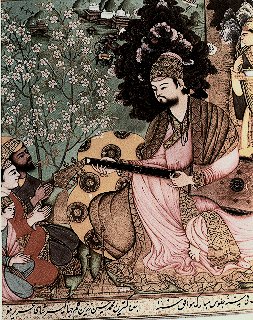
Ali Adilshah had no peaceful time. There were coteries of Persian descendants, Habshis (of African origin) and Dakhnis (Local Muslims) who tried to be nearest to throne. The King was assassinated when he was away from the capital. With young Ibrahim on throne Chand Bibi ruled as regent for 10 years (1580-1590).
But things turned worse in Ahmednagar, land of her birth after her brother's death. Burhan Ul-Mulk had nominated his son Ibrahim as his successor. But this move was opposed by the commandant and civil war followed. Chand Bibi reached Ahmadnagar in time and helped her nephew to ascend to the throne. Shortly after, Ibrahim died in a battle, nobles revolted and infighting followed. Taking advantage of the weakened royalty, Mughal army under the leadership of Emper Akbar's son Murad, laid siege to Ahmadnagar. Chand Bibi, donning armour and shield herself led the army to battlefield. Timely arrival of Bijapur army made the Mughal army recede. Murad agreed for a treaty for a fort. Food for soldiers was getting short day by day and Chand Bibi agreed for a truce.
After some time infighting raised its head again. This time, the noble Chand Sultana who had rushed to save her fatherland and throne was made butt-end of hatred by the feuding nobles. Mughal army made its appearance again under Daniyal another prince and his father Emperor Akbar who came to Deccan was at the remote control. False news was spread that Chand Bibi was handing over the kingdom on a platter to the Mughal Emperor. The infuriated and misled mob assassinated Chand Bibi and Ahmadnagar was an easy march to the powerful Mughals.
Thus ended the life of a nobel and highly talented and chivalrous queen who had come to help her kith in danger, though her own rightful home of Bijapur was peaceful, prosperous, and the ruler was highly respectful and affectionate. She could have led a peaceful life, avoiding gory death.
© 
Autograph of
A very old painting of Chand Bibi on horse-back racing with a hawk, and hunting dogs accompanying exists. Perhaps, hunting was also her favorite hobby. She is a shining example of enlightened atmosphere existing in South India where brave Muslim women also could cultivate arts, hunt and lead the army on the battle field, when the occasion rose.
See Also:
• Indian History