


This setup is possible by 1) reading devotional literature, 2) doing continuous prayers, remembering God's grace all the time, 3) keeping company of holy men, and give up desire and anger. These instructions were for those who wanted to be loved by God. Those who wanted to face several hurdles in everyday life could also equip themselves with a strong mind if they practiced the guidelines provided in Narada Bhakti Sutras.
It is believed that there are three paths for spiritual practice. Jnanayoga, Bhaktiyoga and Karmayoga. Jnanayoga is concerned with intellect, Bhaktiyoga with emotions and Karmayoga with will, which directs humans for different activities. A person is free to adopt any one of the path. All the paths help purity one's soul. Assimilation of all the three is the highest goal. Narada the author has tried to have a synthesis of all the three forms, but as name of the text suggests, the stress is on devotion or Bhakti only. Bhakti in this context is transcendental experience of bliss and very different from ordinary meaning of 'love' or 'devotion'.
Bhakti or Divine love manifests itself in eleven forms:
- Love of glorification of the Lord's blessed qualities
- Love of his enchanting beauty
- Love of worship
- Constant remembrance
- Love of service
- Love of God as a friend
- Love of God as a son
- Love for God as of a wife or husband
- Love of self-surrender to God
- Love of complete absorption in God.
- Love of pain of separation from Him. Any form was as sacred, pure and perfect for realizing Him.
Names of mythological characters are given to elucidate this point. But it is stated that ultimately, only love of the absolute, eternal Truth is the greatest. 'Bhaktireva Gariyasi' says Narada and through such intense Bhakti only the Lord manifests himself to the devotees. The last form of divine love, that of separation is characteristic of several saints of India which itself is manifested in many of their utterances.
© K.L.Kamat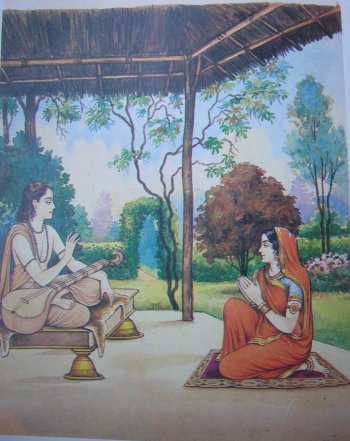
Narad Teaching Kayadhu
Kayadhu later married Hiranyakashapu and bore Pralhad