

Education of Belawadi Mallamma
Belavadi Mallamma was the daughter of Sode king Madhulinga Nayaka and went on to defend her husband's kingdom against the mighty force of Maratha leader Shivaji, winning the latter's admiration and respect for her bravery. Scholar Shesho Srinivas Muthalik has recorded the life in the palace of Madhulinga Nayaka in 1704-5 A.D. in Marathi language. Some excerpts:
______________________
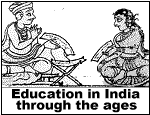
When Mallamma became five years of age, her education began along with her brother Sadashiva Nayaka. Both of them were taught Kannada, Marathi, Urdu, and Sanskrit languages. It took them ten years to learn them all. The brother and the sister were very close and studied together. A school was built for their education and ten senior Shastris were appointed as teachers. There were boys and girls belonging to various castes (Havyaks, Gowda Saraswats, Nadavars, and Madhwas) in about equal numbers. Shankar Bhat was the principal of the school and was a great scholar. Mallamma was a very good student and intelligent one. Everybody admired her intellect. She was drawn to poetry when she was about twelve years old. Sadashiva Nayaka was also fond of poetry and wrote poems in Kannada. The king father Madhulinga Nayaka arranged for all the boys to undergo military training and appointed brave men by name of Ranavir Singh. Mallamma showed interest in learning fencing and archery. She could compete with the boys in horse riding and throwing the javelin.
Mallamma had great respect for teachers and parents and God. She would get up in the morning and get ready and offer prayers to lord Shiva. Then she would go to the school.
______________________
This shows that girls of royal families received the same education as the males. It shows the broadmindedness of the Sode (a.k.a. Sonde) kings who provided co-education in the seventeenth century.
References:
- Shivaji-Mallamaji Samarotsav (in Marathi), Kannada Department, University of Mumbai
- Kamat Jyotsna, Karnatakada Shikshana Parampare (in Kannada), Kannada Department, University of Mumbai, 1988