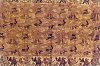
Flower basket on a Banarasi saree.
|  |
 |  Golden basket and blue flowers.
|
 Golden basket with violet flowers.
|  |
 |  Yellow leaves and green flowers.
|
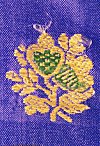
 Golden Leaves and Red Fruits Embroidered design from an Indian drape |  |
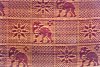
 |  Parrots, elephants, deer, peacocks, tigers are used to embellish the exquisite silk sarees.
|
 An elephant and a parrot of same dimensions!
|  |
 |  Highly skilled weavers produce excellent brocades of different animals among floral designs.
|
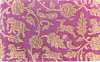
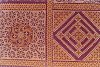
 A mosaic pattern produced by weaving geometrical elephant motifs.
|  |
 |  "Tie and dye" (Bandhani) is an ancient craft still practiced in Rajasthan. It is complex method of embellishing sarees by tying tiny knots that from the design and then dyeing the fabric. The knotted area remains uncolored. The process is repeated until t
|
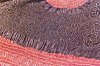
 "Appliqué" or patchwork is an integral part of the textile crafts of Gujarat and Rajasthan.
|  |
 |  Sarees of the East The tribal women of Nagaland, Mizoram, Tripura, Arunachal Pradesh, Manipur weave their textile on the traditional back-strap or loin-looms. It can be set up instantly and folded up and put away whenever women are not working. |
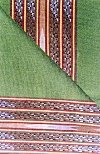
 Dhaka (East Bengal) sarees have geometrical designs produced with plant colors.
|  |
 |  The yarn is tied and dyed repeatedly so that when weaved the colors and patterns synchronize to form "Ikat" designs. It is practiced in Orissa, Andhra Pradesh and Gujarat.
|
 Prior to weaving the warp is tied in portion according to design and then dyed, which results in special "Ikat" patterns.
|  |
 |  Very simple geometrical designs are produced on inexpensive sarees.
|
 Kanchipuram Silk Saree Kanchipuram silk sarees are well known for their durability. These Tamil Nadu weavers claim that they are descendant of sage Markandeya. |  |
 |  Inter-woven pattern of "Chunari" saree.
|
 Designs on an Indrian Throw "Chaddar" or shawls are used to keep warm in the winter. In older days "Zari" threads were used for their embroidery work. However these days multi-colored cotton threads are used for the same purpose. |  |
 |  These shawls have very broad borders.
|
 On light background deep color patterns are woven.
|  |
 |  Floral Designs Hand-looming trade has long been a patron of floral designs and patterns |
 The Himalayan mountain goat's wool is hand-spun and woven into "Pahsmina" shawls.
|  |
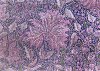
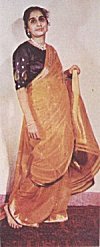
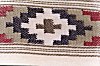
 |  "Durries" are extensively woven all over India and use them as a floor covering.
|
 Bangalore silk saree.
|  |
 |  Mysore printed silk saree.
|
 Nine yard silk saree.
|  |
 |  A Priest of Malleswaram
|
 Holy man at a Ayudha Puja Ceremony
|  |
 |  Portrait of S.N. Krishna Jois Krishna Jois is a great Kannada scholar, and edited such works as Supashastra. |
 Priest of Venugopalaswami Temple
|  |
 |  Portrait of a Priest
|
 Priest of Ganesh Temple, Mallewaram
|  |
 |  The Anandashram Swamiji of Shirali Muth
|
 Portriat of Parijnananashrama Swamiji Parijnananashrama Swamiji led the Chitrapur Muth |  |
 |  Picture of a Hindu Pontiff Pontiff of Chitrapur Muth - Sadyojata Shankarashrama Swamiji |
 Picture of a Hindu Pontiff
|  |
 |  Picture of a Hindu Pontiff Pontiff of the Gokarn Muth |
 The Swamiji of the Gokarn Paratgali Muth
|  |
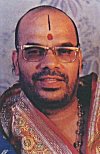
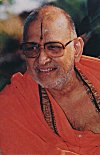
 |  Pontiff of Kashi Muth, Cochin Picture of Sudhindratirtha Swamiji |
 Swamiji of Kaivalya Muth
|  |
 |  Raghavendra Swamiji Offering Prayers to a Linga
|
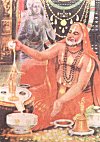
 Raghavendra Swamiji of Mantralaya
|  |
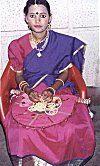
 |  A young girl with her lots of jewelry. Performance of Krishna-Parijat |
 "Jewelry Enhnaces the Womanhood"
|  |
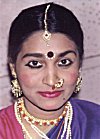
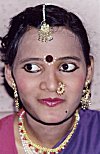
 |  "A sweet smile enhances my beauty."
|
 "Mine is a perfect make-up."
|  |
 |  "Don't I look like a bride, uncle?"
|

 "I am wearing the ornament for a dance performance."
|  |