


The Partition of India
by Vikas Kamat
First Online: August 15, 1997
Page Last Updated: September 03, 2026
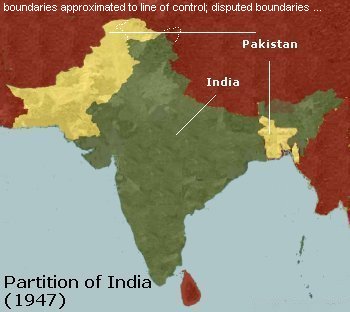
The partition of Indian subcontinent in 1947, following World War II is perhaps the most tragic of all political events to affect India in its long political history. The partition divided Hindus and Muslims who had lived together for hundreds of years. It led to endless boundary disputes, three wars between the two neighbors, a nuclear powered arms race, and state sponsored terrorism. The agony and horrors of partition also gave rise to a new genre of moving art and literature of India.
Reasons for Partition
-
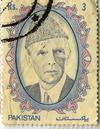
The British who had followed "Divide and Conquer" principle to rule India, had to yield to the "Divide and Relinquish" demands of Muslims -- especially the charismatic Mohamed Ali Jinnah.
-
The British overestimated the popularity of Muslim League that pressed for creation of Pakistan, and didn't understand the fact that there were Muslims living in every village of India, and possibly couldn't be relocated to Pakistan.
-
Some Congress leaders would rather have an early freedom for India rather than convoluted delays in settlement by not agreeing to divide India.
 |
 |
 |
|
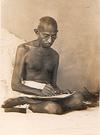
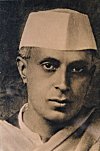
Jinnah, Gandhi, and Nehru |
||
Creation of Pakistan
In what is termed as the greatest human migration, some 15 million people were displaced from their homes as a result of the partition with Hindus in Pakistan moving to areas in Punjab and other bordering areas. Many Muslims left India to succeed in Pakistan ("Land of the Pure") especially many writers and intellectuals. The partition was marred by large scale violence with death of a million (some estimate it up to 1.5 million) citizens and countless others suffering.
K.L.Kamat
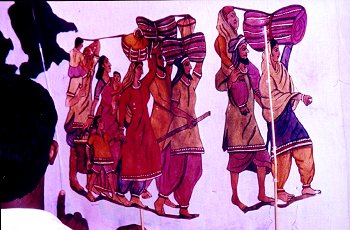
While Gandhi himself was opposed to partition of India, in the end, he could not stop the unfolding of the history and many Hindus blamed his Muslim-appeasement stance. A Hindu fanatic assassinated Gandhi in 1948 in the aftermath of the partition.
Mohammed Ali Jinnah, the "Father of Pakistan", himself passed away barely an year after India's partition.
Creation of Bangladesh
As can be seen from the map above, the newly created Pakistan had two wings --thousands of miles apart with an arch enemy in between. This was recipe for conflict. After all, the people of other wing had more commonality with their neighbors in India (Bengal) than with the Government in Islamabad. The bickering between the two wings caused political and refugee problems for India and in 1971, Indira Gandhi had to act to free the East Pakistan and a new nation -- Bangladesh was created.

See Also:
- The Greatest Migration
- Tryst with Destiny -- The story of India's struggle for freedom remains as a guiding light for resolving the various conflicts around the globe
- Kamat in Karachi -- Kamat writes about his visit to Karachi and the warmth of the Pakistani people.
Links
- Manas: The Partition of India by Prof. Vinay Lal includes pointers to further research.
- Research Abstracts on Partition of India