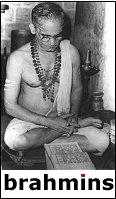


Who is a Brahmin?
by Jyotsna Kamat
First Online: November 02, 2002
Page Last Updated: September 02, 2026
A great example of this tradition (that a person becoming a brahmin, rather than born as one) is the case of Vishwamitra, a warrior (kshatriya), who became a brahmin after attaining brahmavidya, and composed the Gayatri mantra, the most sacred hymn of the Hindus.
A smritis, or code of conduct composed by sage Atri defines brahminhood very clearly.
The Bhagavad-Gita divides1 the class of people into four categories of Brahmana, Kshtriya, Vaishya, and Shudra depending on the traits (svabhava) inherent in individuals."By birth, every man is a Shudra (an ignorant person). Through various types of disciplines (samskaras), he becomes a dwija (twice born). Through the studies of scriptures, he becomes a vipra (or a scholar). Through realization of supreme spirit (brahmajnana), he becomes a brahmin."

1. Chapter XVIII of Bhagavad-Gita, verses 41 - 45 [more]