

The Murals of Karnataka
First Online: August 15, 1997
Page Last Updated: September 03, 2026
© K. L. Kamat
With a distinct style embellished with linear grace and high impact color harmonies, the murals of Karnataka state in southern India have a romantic and exciting history and are equal in artistic value to the better known sculptures from the state.
There is enough evidence to prove that mural art has played as significant a role in the heritage of Karnataka. That the renowned caves of Badami are decorated with this style of painting is enough to confirm that the style was extant before the 7th century A.D. The narrative panels there give an idea of the monarch's daily routine as also the life and times of the people.
© K. L. Kamat
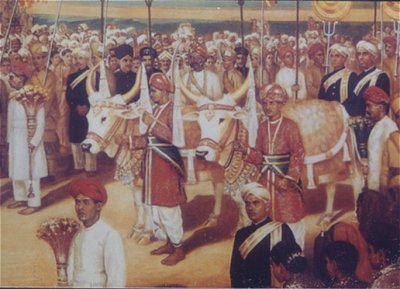
Detail from a Mural at Mysore Palace
Late 19th Century
But the style saw its renaissance only after the fall of the Vijayanagar empire. The beauty and diversity of the style can be seen in the murals that are still extant in different stages of preservation in temples spread over the length and breadth of the old Mysore area. It is true that quite a few of them are in a dilapidated condition: the finer points shrouded due to flaking, soot-formation or even carelessness.
But when compared with murals belonging to the Chalukyan period, these murals of more recent origin give an idea of the progress made in aspects of structure and design. Thus it can be safely said that the style enjoyed a certain amount of continuity under the patronage of the Mysore dynasties, including that of Hyder Ali and Tippu Sultan.
We also see a type of mural art done in monochrome very prevalent on the
western coast of Karnataka.
See: Kavi Art of Coastal Karnataka -- Article and a number of pictures on the durable form of monochrome art known as the Kavi Art prevalent on the Indian West-coast.
© K. L. Kamat
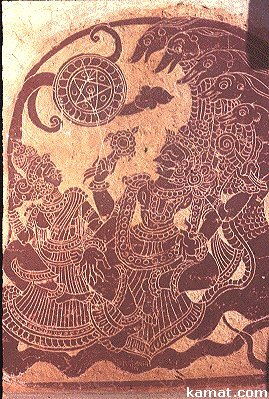
Romance of Lord Vishnu and Wife Laxmi
Kavi art murals are found on the Indian west coast. In the mural above, the couple is shown relaxing on a five hooded snake
The Techniques
From the ancient texts on fine arts, it can be gathered that the basic necessity for the style is a smooth, plastered surface. That means it does not demand a wet surface as in the frescoes of Italy. This starting surface (bhitti or mani bhoomi) is prepared by using a mixture of powdered bricks, clay, kernels of Bilva (a type of fruit, Aegle marnelos), guggula gum, beeswax, jaggery and oil in different proportions. Lime prepared from seashells is also an important ingredient for this mixture, along with the sawdust of a particular bark.
The mixture, after being stored for about a month, is applied to the wall to obtain a smooth surface. It should be as bright as a crystal in order to be able to obtain the desired results.
© K. L. Kamat
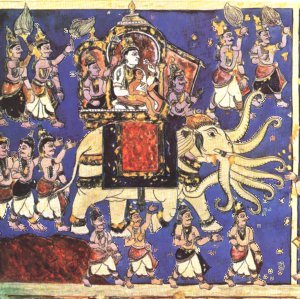
Lord Indra riding the Iravat, the eight trunked elephant
Mural from a Jain Muth, Sravanabelagola, 18th Century
See Also: Mural from Sira, 1800 A.D., Lepakshi Paintings in Ruins
References
- Karanth S. K., Karnatakada Chitrakale (in Kannada), Karnataka Arts Academy
- Chandrashekhar S. N., Murals of Karnataka Portfolio, Karnataka Arts Academy
- Kamat K.L., The Timeless Theater CD-ROM, CyberCrow, 1999

See Also:
- Monochrome Marvels -- Till Kamat presented his scholarly analysis of this rapidly vanishing art form, nobody recognized Kavi art as an art form. Nothing has been done since then.
- The Art of Lepakshi
- Mysore Traditional Paintings