

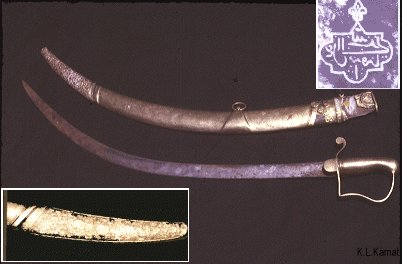
The Sword of Tippu Sultan
by Dr. K. L. Kamat
Editor's Note:
Dr. Kamat wrote this article in the year 1999 on the occasion of the bi-centenary of Tippu Sultan's death. Tippu was a controversial ruler due to some of the atrocities attributed to his regime -- especially on Konkani speaking Christians and due the massacre of brahmins at Melukote, but Dr. Kamat has tried to evaluate him historically and above controversies.
"The Sword of Tippu Sultan" is also the title of a book by Bhagwan Gidwani, and a controversial TV serial in India. -- Ed.
First created: May 04, 1999
Last Updated: September 03, 2026
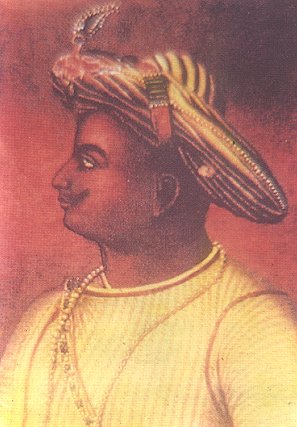
Tippu Sultan (1753-1799)
Childhood and Parentage
Tippu was born in Devanahalli (in Karnataka) on Friday, November 20th, 1753. At the age of fifteen he used to accompany his father Hyder Ali, Ruler of Mysore State, to different military campaigns. He was a devout Muslim. He had a very inquisitive mind and fascination for learning. His personal library was consisted of more than two thousand books in different languages. Tippu was a man of simple habits, eating common food and leading pious life. He had a very dignified personality and impressed the people who came in contact with him. He was an extremely active man and worked from dawn to midnight for the welfare of his subjects. He himself drafted all his correspondence. He took over the kingdom after his father's death in 1782 A.D.
Fighting the British
He could foresee the (British) East India Company's design to get entrenched on Indian soil, and took a vow to foil it. For this purpose he negotiated with the French and sheltered the Frenchmen who preached the French revolutionary doctrines to the public. A "Jacobean Club" was established in Tippu's capital Srirangapattana, and the French tricolor was hoisted. He also sought assistance from the Amir of Afghanistan and the Sultan of Turkey. He had already defeated the British at Wandiwash in 1783. The British were very scared of Tippu's growing strength, and they formed an alliance with the Nizam of Hyderabad State and Marathas of Maharashtra State. The French deserted Tippu after signing of the "Versailles Treaty" in Europe in 1783 when the American War of Independence ended.
As long as the British fought alone, Tippu always defeated them. But he was no match for their diplomacy, conspiracy and intrigue. Thus he was defeated in his Capital of Srirangapattana, and forced to sign a humiliating treaty on March 22nd, 1792. As a result he had to concede half of his kingdom and pay an indemnity of thirty three million Rupees to the English and their allies. Frequent wars had drained his treasury, and hence he had no hard cash to pay this huge amount. He was compelled to pledge two of his sons to the conquerors. Governor General Conrnwallis took away these two youngsters to his headquarters in Calcutta in Bengal. However, they could not suppress Tippu's spirits for long, and he rebuilt his war machine in shortest possible time. He built a fine army and modernized his administration on the European model. He was an able and fearless military strategist.
Tippu's Government
He built a chain of excellent roads, and constructed tanks and dams to promote agriculture. He introduced the new industries, promoted trades and commerce, established factories in Cutch, Masquat, and Jedda, and sent commercial missions to Oman, Persia and Turkey. He invited foreign know-how to build factories to produce glass, mirrors and ship-building. He aimed at making his kingdom the most prosperous state of India. Hence he was also interested in latest scientific research all over the world. He introduced sericulture on a large scale, and mulberry cultivation was started at twenty one centers. He encouraged the textile industry by banning the export of cotton. The weavers from Tamilnadu were invited and settled in his kingdom. Growing of sugarcane and producing of sugar and candy were encouraged in Channapatna, Devanhalli and Chikkaballapur. High quality tempered wire required for the string instruments was produced in Channapatna. The livestock development got special attention. Tippu prohibited the production and distribution of liquor and other intoxicants in his state of Mysore.
Tippu Sultan adopted the tiger as his emblem. His throne was shaped like a tiger, carrying the head of a life-size tiger in solid gold (see also the boxed toy above). He was an enlightened ruler who treated his non-Muslim subjects generously. He appointed them to different positions of authority, and gave them complete freedom of worship. He conferred liberal grants to Sringeri, Srirangapattana, and Mangalore temples. He gave funds for the consecration of idols and presented them with gold and silver articles. He also encouraged arts like music and dance and learning in general.
|
|
|
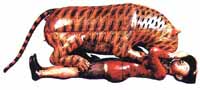 Tippu's Toy Tippu's Toy
The mechanical 'Tipoo's Tiger' was captured at Srirangapattana in 1799 and was exhibited at the East India Company's headquarters in Leadenhall Street. The tiger roars and the British officer screams. Picture Courtesy : |
Tippu, the Builder
The most famous and beautiful artifact from Tippu Sultan's period is his summer place, the Daria Daulat. It beautifully depicts some of the heroic wars Tippu fought and also many social themes of the period.
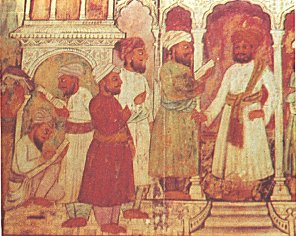
Painting from Daria Daulat Bagh
Tippu built the "Gumbaz" at Srinagapattana in 1784 which is a square shaped mausoleum with ivory-inlaid doors and black marble pillars. Tippu is buried here by the side of his father Hyder Ali and mother Fatima Begum. Outside the tomb are the graves of his relatives and commanders. Nearby the "Mashit-e-Aqsa" mosque, with a pair of small minarets is located. A solar clock could be found outside this building.
Tippu built and fortified numerous forts, but unfortunately most of them are either destroyed or are in ruins because of poor maintenance. The Bangalore fort, located in the heart of the city has a temple of Ganesh where devotees offer prayers regularly. Tippu also built many palaces which were demolished by the British after his death. However his Bangalore Summer Palace is a great tourists' attraction. It is completely made of wooden structures with five well decorated and painted arches.
Tippu's Legacy
"Sword of Tippu Sultan" is the name of a novel by Bhagwan Gidwani based on his life. Based on it, a serial was telecast by Doordarshan (the state run television in India) which became both popular and controversial. On the 4th of May, 1999 Tippu's death bicentenary will be celebrated in India on a large scale. Though the historians of India are of different views about his role to dislodge the British from Indian soil, the common people have great admiration for his heroic deeds. It is very interesting to note that seventh generation descendants of Tippu Sultan have arrived at Srirangapattana, all the way from Calcutta to claim their ancestral properties!
The Daria Daulat Bagh is a national monument and can be visited by tourists (1999).
(Editor's Update: year 2018)Tippu's birthday is being observed as a holiday in the state of Karnataka, mostly seen as pandering to Muslim population.

See Also:
- Indian History at Kamat's Potpourri
- A Timeline of India
- Paintings of Daria Daulat Bagh
- Jai Karnataka -- Topics on Mysore and Karnataka
- Author's Home Page
Internet Links:
- Wars and Agreements of Tippu Sultan
at Islamic Voice

- The Tiger of Mysore