





Most of us cannot fathom living a life without electricity. But we should not forget that availability of electricity to consumers is a fairly recent event.
My grandma remembered the year my town got electricity as if it was an epoch. It was the root year based on which she did the date math; "My son Gajanan was born the year we got power.","We bought this house two years before Honavar got current (that's how she referred to electricity)." etc.. I say that because a number of people amongst us were born before the advent of electricity.
Once I went to a village in India (the village of Nilkod near Kumta) which had no electric power connection as yet. The night arrived early, and the village folk finished all their activities before dusk. Only leisurely dinner was partaken at night. People chatted and sang for entertainment. I was in Nilkod only for a few days, but the mystery and enigma of black night has remained with me forever. There's something sincere and honest about respecting the night.
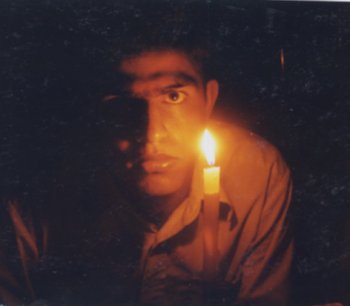
Of course, growing up in India, the power shortages and power outages were very common. During important TV broadcasts like Cricket match or Ramayana show, the townspeople had to make sure the power would be on (by bribing the electricity department employees, for instance). The students preparing for cut-throat competing tests were special victims of these regularly irregular "power sheds" or failures. The following picture (a self-portrait) was taken while preparing for one such test, probably in 1985.
© Vikas Kamat
In his book "The Return Journey", my father has criticized the introduction of electricity to rural India when India did not have the means to generate or meet the electricity demands of her population. "Vegetable oil lamps (undal oil) were a environmentally sound means of providing light before the arrival of electricity in Honavar. The whole infrastructure of growers to oil mills, to merchants who sold them, was rendered unemployed, when people switched from oil lamps to electric bulbs. Yet, the energy requirements of the people was not met!"
I absolutely agree with Bappa that progress-for-progress's sake is one the problems of India that has resulted in such grave disparities. Before the electricity was introduced, the darkness affected rich or poor with the same intensity. It's the same story with sugar, and personal automobiles. Anyway, I digress.
Along with poverty, shortage of energy is definitely one of the major problems facing the world today. And from recent engineering accidents (New England, Italy), distribution of power is another of them. It's just like food. Today there is enough food for every man, child, and animal. But the problems in distribution and inability to afford the food has led to widespread hunger and poverty.

See Also:
• Notes on Self-Sufficiency