





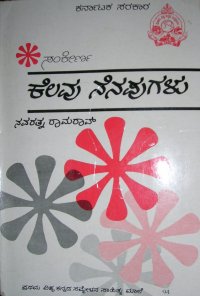
I have been reading the autobiography of Navaratna Rama Rao (Kelavu Nenapugalu in Kannada language). It is an extraordinary book for several reasons and just what I needed to deepen my understanding of life, India, and Hinduism.
The author was a highly placed officer in the royal government of Mysore Maharaja (see Wodeyars) and recollects his experiences of governance, reflections of people. Set in the early years of 1900, it is full of fascination and amusements.
For one, Navartna Rama Rao is not a writer, this is his only published book. The prose lacks literary merits, yet it is an invaluable literary work because who else could have told this story?! The author came from a very scholarly and well-respected families, was exposed to law and English (both the language, and the people), was a room-mate of Rajagopalachari, and decides to serve the people of India, as if that is his sacred duty. None of the period literature has the authenticity nor filled with as many personal historical anecdotes as Rama Rao's book.
Secondly, I think it will end once for all, the arguments I have had for years with Amma about role of royalty in pre-and-post independent India. Like all young people, at all times in my life, I have viewed the royals only with utmost contempt. The book gives deep insights into the distinctly Indian form of governance, of maintaining law and order, of taxation, as practiced by the kings taking into consideration the local customs, castes, and local economies.
Navaratna Rama Rao was a remarkable man. Throughout the book, he cites examples of using common-sense and sense-of-justice to make difficult decisions. At every moral dilemma, he digs deep into his own character and upbringing to find solutions.
I also admire author's judgment in disclosing names of towns and people, as it is a very delicate problem faced by autobiographers. Especially since he was a public figure, he had knowledge of a lot of inside politics, inside affairs and I believe he has protected the private matters of common men at the same time exposing the shallowness of some leaders.
Lastly, the author has used colloquial language freely and has apologized for it in the introduction. I believe that the apology is uncalled for, and rather we must be thankful to Navartna Rama Rao for enriching the language by using so many administrative words derived from Marathi, Persian, and old Kannada.
I highly recommend this book to Indians who are trying to find themselves, or having a mid-life-crisis, or those on a learning vacation.

See Also:
• Book Recommendations
• More Reviews